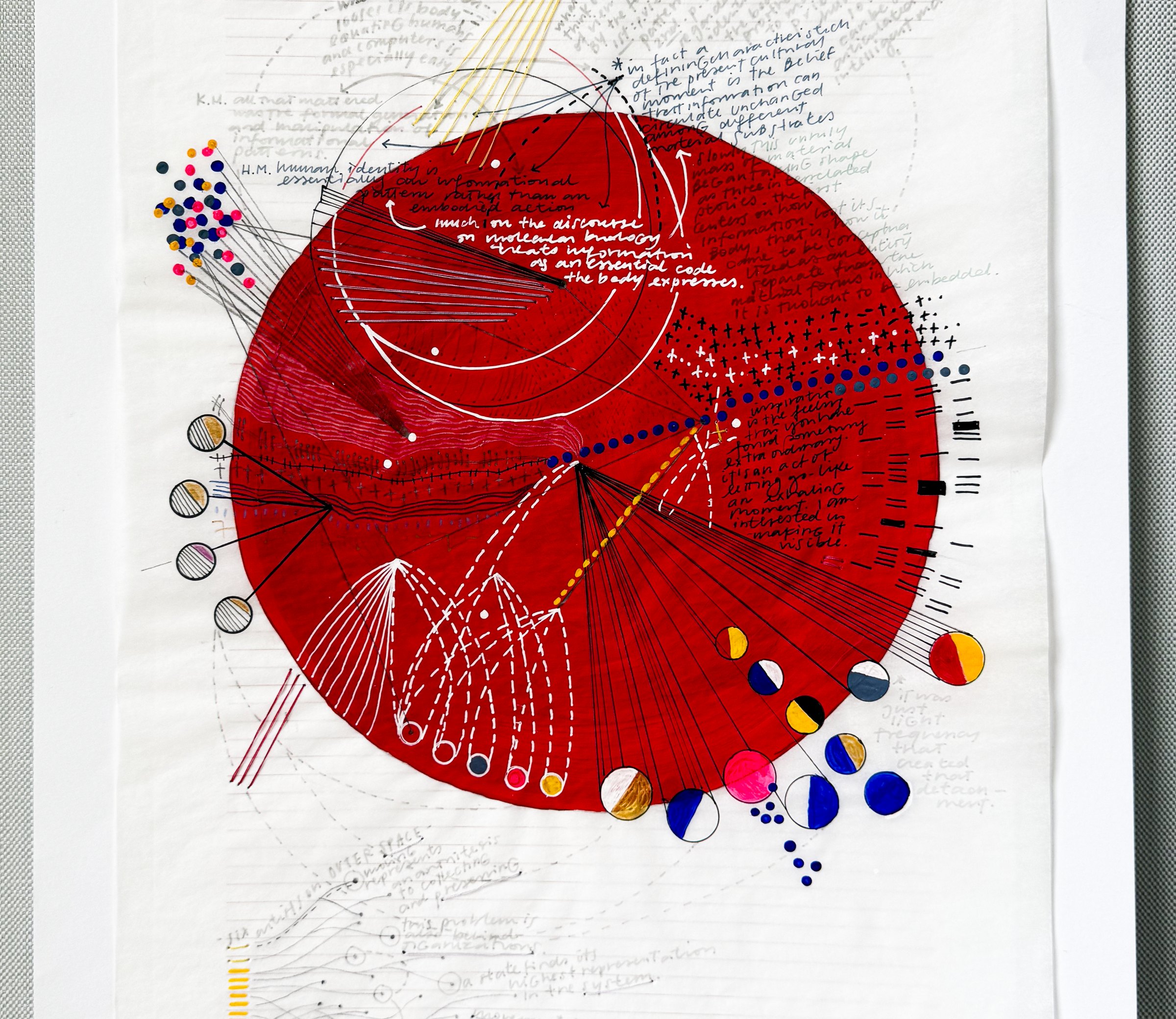
I think in diagrams. I build visual languages and systems of marks and symbols to study what it is to be human: the self, our relationships, the stories we tell ourselves, the wounds we are trying to heal, and also the lighter quirks that make us who we uniquely are.
I work at close range, at the scale of a single person and the people around them. I believe that the larger collective problems we face can only be approached once we fully understand ourselves and our own protective mechanisms: the ones that make us reactionary, the ones that make us behave in order to obtain security, validation and pride from the outside world. Fully recognizing oneself, and therefore the self in others, is where I begin.
Each piece starts from a subject I am trying to understand. I gather what I am reading, listening to and learning about it, and work through the models other people have built for the same purpose: the models psychology has built for the parts of a mind, the subtle body as ashtanga describes it, the graphic scores of Fluxus, the notation of choreography. Every one of them is a human abstraction of a person, made by somebody, with things left out. I take them apart by hand to see what each one explains and where it stops.
I began this studio practice in 2025, working on paper and canvas. It runs alongside my design practice. What I am exploring is how far the idea of a diagram itself can be pushed, and how a diagram can become the starting point for a more intimate language, made with the tools and materials of fine art.
I call them Modelli Circolari, and they stem from my obsession with the things I am eager to understand or fascinated by. Each piece has an inner focus circle that hosts symbols, connections, diagrams and words.
01 · redhumans, consciousness and technology, stemming from earlier studies on intelligent machines
02 · bluethe hidden structure of personal identity and its evolution
03 · goldgraphic scores from the Fluxus movement; visual notations to convey musical structure
04 · pinkthe subtle body, as described in ashtanga yoga
05 · yellowmy own Mysore ashtanga practice — the primary series, as it was taught to me by the wonderful teachers at @theshalanyc
06 · greenchoreography, from one of my last contemporary dance performances when I used to dance in Italy
07 + 08 · splitthe dynamics and anatomy of a romantic relationship
09 · light redthe world of Internal Family Systems
The structure loosens and spreads, and the logical diagram of a particular subject overlaps with the more impulsive and emotional side of it. This time, spatially, I use the idea of fractures and margins in the paper and in the color to discover these.
01a path to getting past the self's protective parts, to be able to reach the more vulnerable ones that have been kept safe.
02"essere umano": being human and human being. Solitude and loneliness. Repetition that anesthetizes.
03the fractures, margins, misaligned moments to be climbed over.
04the stories we keep running in our minds, unpacking them so they stop getting in the way.
05here and now, and the many timelines that are ahead of us. Finding a higher level of coherence.
06how do we make sense of something as complex and ungraspable as memory? This is a map of it.
Each piece begins as two separate diagrams — two subjects, two systems of marks — laid directly on top of each other. The overlap creates something I didn't plan for: a third shape, somewhere between the two. In the overlap I understand more of both ideas I am exploring.
Sewing patterns are among the most intimate technical drawings that exist — a system built to fit one specific body, to account for its particular measurements and proportions. These pieces borrow that language: graph paper, construction arcs, notch marks, seam allowances. The annotations circle questions about modeling itself — what it means to take a measurement, to reduce something living to a set of parameters.
Discombobulated maps of my studio taken apart, with the objects and plants wandering around and chasing each other. Some lines dive into their own color, and some get tired of it and put on a different one halfway. Games of lights flatten up on the canvas.
The most openly ironic series — small, quick, made on purpose with humble, almost throwaway materials. They belong to an Italian lineage of the playful conceptual object, where something modest is asked to make a serious point; the idea matters more than the making.
Everyday materials given philosophical problems through image and Italian text. A bundle of brushes, a tangle of thread, a row of matchsticks — each piece pairs its object with a handwritten aphorism. The objects don't illustrate the words. They think alongside them.
Writing that can be kept without being read. The hand moves through the full motions of journaling, forming letters, following lines and releasing what is underneath, but the script is stripped just far enough from legibility that not even I can read it a few minutes later.
The illegibility is built in from the start: a way of having the page without the exposure. The body does the work of letting go, and what remains is the visual trace of that. Some are almost graphic, studying how text sits on a surface and what different formats already say before a word is written: the letter, the list, the timeline. Others are purely gestural, the handwriting loosening into something closer to weather than language.
Structures layered over structures, each made in a different logic and technique resembling notations, connections and relationships.
Gestural ink paintings annotated with the actual timestamps of each stroke — when it was made, in sequence. The act of painting becomes the data being recorded. What's usually invisible in a finished piece — the rhythm, the pauses, the duration — is written into the surface.
Watercolor botanicals layered over white patterns that suggest root systems, sound waves, growth rhythms. The white marks function as a kind of alphabet, whether it's our language imposed on the plants or their own communication system that we can't quite decipher. These paintings ask what's happening beneath what we can see and what forces and patterns exist beyond our usual ways of knowing.
A journal where I finish paint left on my palette and test colors from other pieces. An accidental archive of what happens in the studio between the intentional pieces.